
Carmina Burana

featuring
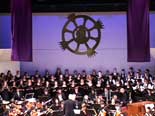
Carmina Burana
by Carl Orff
Regents Theater, Holy Names University,
3500 Mountain Blvd., Oakland, CA
Robert Wells Choral Director Ric Zappa
Produced by Berkeley Citizen and viewed on Berkeley Public Access Cable TV
PROFILESLara Bruckmann
Carmina Burana
Lara Bruckmann
John Minagro Baritone
Ben Barr/Jimmy Kansau Tenor
Jeanie McKenzie, Sarah Noll and Avery Stefan Dancers
Da Capo and CantabileFortuna Imperatrix Mundi (Fortune, Empress of the World)
1. O Fortuna (O Fortune)
2. Fortuna plango vulnera (I bemoan the wounds of Fortune)
Part I Primo vere (Spring)
3. Veris leta Facies (The merry face of spring)
4. Omnia sol temperat (The sun warms everything)
5. Ecce gratum (Behold, the pleasant spring) Uf dem anger (On the Green)
6. Tanz (Dance)
7. Floret silva (The noble woods are burgeoning)
8. Chramer, gip die varwe mir (Shopkeeper, give me colour)
9. Reie (Round dance) Swaz hie gat umbe (Those who go round and round) Chume, chum geselle min (Come, come, my love) Swaz hie gat umbe (Those who go round and round)
10. Were diu werlt alle min (If all the world were mine)
Part II In Taberna (In the Tavern)
11. Estuans interius (Burning inside)
12. Olim lacus colueram (Once I lived on lakes)
13. Ego sum abbas (I am the abbot)
14. In taberna quando sumus (When we are in the tavern)
Part III Cour d*amours (The Court of Love)
15. Amor volat undique (Cupid flies everywhere)
16. Dies, nox et omnia (Day, night and everything)
17. Stetit puella (A girl stood)
18. Circa mea pectora (In my heart)
19. Si puer cum puellula (If a boy with a girl)
20. Veni, veni, venias (Come, come, O come)
21. In trutina (In the balance)
22. Tempus et iocundum (This is the joyful time)
23. Dulcissime (Sweetest one) Blanziflor et Helena (Blanchefluer and Helen)
24. Ave formosissima (Hail, most beautiful one)
Fortuna Imperatrix Mundi (Fortune, Empress of the World)
25. O Fortuna (O, Fortune)Intermission
Note: The first half of the Winter Concert 05 program (see below) is not represented in the above video.
Counterpoint
Brandenburg Concerto No. 3, 1st Mov*t.......................................J. S. Bach (1685-1750)
Concerto Grosso in A Minor, Op. 3 No. 8, 1st Mov't......Antonio Vivaldi (1678-1741)
Christina Hsu and Ramya Parameswaran, Violins
Cantabile
Messe Brève........................................................................Léo Delibes (1836-1891)
Daniel Walden Violin I Ramya Parameswaran Violin II
Yaeir Heber Viola Sara Lempert Cello
I Kyrie
II Gloria
III Sanctus
IV Agnus Dei
Sidney Matthews and Madeleine Nelson, Soloists
Colla Voce
Liebeslieder Walzer, Op. 52 (selections)..................Johannes Brahms (1833-1897)
Kim Rankin and Renée Witon Piano four hands
Nr. 1 Rede, Madchen, allzu liebes (Speak, dearest maiden)
Nr. 2 Am Gesteine rauscht die flut (Upon the rocks the high tide breaks)
Nr. 3 O die Frauen (Oh women)
Nr. 4 Wie des Abends schöne Röte (Like the evening’s beautiful sunset)
Nr. 5 Die grüne Hopfenranke (The green hop-vine)
Nr. 7 Wohl schön bewandt war es (How very pleasant it used to be)
Alysha Bedig/Lauren Skinner Alto Soloist
Nr. 8 Wenn so lind dein Auge mir (When your eyes so gently)
Nr. 9 Am Donaustrande (On the Danube*s bank)
Nr. 10 O wie sanft die Quelle sich (Oh how gently the stream)
Nr. 11 Nein, es ist nicht auszukommen (No, it is impossible to get along)
Nr. 13 Vögelein durchrauscht die Luft (A little bird rushes through the air)
Nr. 17 Nicht wandle, mein Licht (Don*t wander, my light)
Justin Louie Tenor Soloist
Nr. 18 Es bebet das Gesträuche (The bushes tremble)
Lara has sung and acted on many Bay Area stages, including the Plush Room, Palace of Fine Arts, New
Conservatory Theatre Center, The Legion of Honor, Scottish Rite Temple, EXIT, ODC, Venue Nine, New Langton Arts, Jazz House, and Ruby Skye. Her many acting and musical theater credits include Man of La Mancha, Into the Woods, They're Playing Our Song, The Lights, Don't Dress for Dinner, and Bye Bye Birdie. Lara has performed with the Pforzheimer Opera, at the Colorado Lyric Theatre Festival, and has placed in competitions hosted by West Bay Opera, East Bay Opera League, and NATS. Lara is member of Volti, a 20-voice chamber choir that performs exclusively 20th-Century and new music. Last September, Lara premiered her original one-act cabaret style play "divagation: an internal cabaret" at the San Francisco Fringe Festival. Lara is now spending much of her energy developing a new show with the saucy cabarettrio Gilkulture. Lara teaches private voice lessons, directs elementary and middle school choirs for the Oakland Youth Chorus. She is also founder and director emeritus of Arts First Oakland. Lara holds degrees from Rice University and The New England Conservatory.
John Minagro
A versatile John Minágro is frequently seen in many genre of vocal music including Opera, Oratorio, Concert and Musical Theater. Theater credits include the major roles in Applause, Li'l Abner, The Ghost and Mrs. Muir, Guido in Nine, and Man of La Mancha. A NATS First Place division winner, he has performed the title roles in Gianni Schicchi, Aleko, Ruslan and Ludmila, and Noyes Fludde. John has performed chorus or solo work in locations from Lincoln Center in New York, to the Salt Lake Mormon Tabernacle, and locally at the Concord Pavilion. He was the laced and coifed figure Don Attilio in the San Francisco tour of The Phantom of the Opera, which played for five- years at the Curran Theater from December 1993 to 1998. He has also been the guest soloist with the San Francisco Symphony at their Summer Broadway Pops Concert.
Sarah Noll
Sarah Noll is in her sixth year as the lower school music teacher at Head-Royce. She is also the director of Da Capo, the lower school choir of fourth and fifth graders. After majoring in piano in college, she began to work as a musician for dancers. Sarah is trained in dance and mime. She began teaching movement and music to children in New York City and discovered the Orff-Schuwerk approach to teaching music. She has performed with an adult Orff performance group, Xephyr, for the last ten years and has participated in the summer course of the Orff institute in Salzburg, Austria. Sarah taught the movement component of the Orff training course at Mills College in 2003 and has presented Orff workshops for California Association of Independent Schools and at Orff conferences.
Kim Rankin
Kim Rankin received her training in piano and conducting at Duke University and U. C. Berkeley. She has been active in the Bay Area for several years as a choral conductor, accompanist, singer, and musical theater director. She is currently the Director of Music Ministry at the First Unitarian Church of Oakland.
Robert Wells
Mr. Wells received his vocal performance training from the New England Conservatory and a conducting degree from San Jose State University. Mr. Wells currently conducts five Head-Royce choirs and is in his twelfth year as the vocal music director. The Head-Royce Chorus, Colla Voce and Cantabile all received gold awards at the Anaheim Heritage Festival in May, 1999, and all three ensembles participated in the Heritage Festival of Gold in Salt Lake City in May, 2000. The Chorus and Colla Voce each received unanimous superior ratings at the California Music Educator's Association Choral Festival in San Jose May, 2003. In addition to his choral music responsibilities, Mr. Wells is the ninth grade dean of students at Head-Royce School.
Renée Witon
Renée Witon is the primary accompanist at Head-Royce and maintains a private piano studio at her home in Oakland. Renée also teaches music theory for the San Francisco Girls Chorus and is the Assistant Music Director at the First Unitarian Church of Oakland. She has recorded and produced her own CD of classical piano music, available at CDBaby.com. Renée enjoys co-hosting a weekly radio classical music program on 90.3 KUSF, Classics Without Walls.
Ric Zappa
Ric is in his tenth year as instrumental director at the Head-Royce School. He received his BA from Hunter College and MA in Composition from Mills College. He studied composition with Louie Martin, Myron Fink, and Louise Talma; contempory composition with Larry Polansky; and jazz composition with Anthony Braxton. Ric is founder and former director of the Oakland Civic Orchestra, former conductor and artistic director of the Diablo Valley College Orchestra, and former faculty member of the San Francisco Girl's Chorus. His works are published by Seesaw Music Corporation.
All Rights Reserved