
Berkeley's Storm Drain System
Portal to the Bay

Berkeley's Storm Drain: Portal to the Bay. (1992) 8:30 TRT Produced by Erbele/Wood Berkeley's Storm Drain: Portal to the Bay. (1992) 8:30 TRT |
The Blue Planet
L A Wood
Council of Neighborhood Associations newsletter
September 1992
Recently I saw a photo of the Earth taken from nearly l00 miles up in space. At that distance it is a blue planet. The image reinforces what I was told in grade school, that three quarters of the planet's surface is covered with water. In the picture, this majestic sphere is perfectly suspended and beautifully blue. Until recently, I had managed to hold on to this childhood image of a blue planet, a living planet. In the last several months, I have come to realize that the earth is dying a certain death.
Every day the oceans and groundwater are being poisoned. There has been an accumulative effect from decades of polluting our ground, air and aquifers. The blue has been transformed to gray. The planet still appears blue. Pollution in groundwater often times cannot be detected by the human eye. The environmental transformation has been gradual. A recognition of this fact came to me while being involved in an environmental stop-action directed at the City of Berkeley's Public Works vehicle maintenance facility.
We all have experienced seeing a dripping faucet in need of repair. Because it was not in our own home or because we didn't understand the magnitude of the water loss, we failed to act. Maybe we considered the environmental impact to be small. Perhaps it was someone else's faucet, so we said nothing and did nothing. The dripping faucet is symbolic of our past approach to issues of environmental pollution and is indicative of our failure to consider the drip to be our personal concern.
The community inside the Berkeley's Corporation Yard is a cross section of laborers, skilled and professional trades. It is the center for much of the City's activities and brings a multitude of City staff to the Yard. Yet, in the midst of all those eyes, at the southwest corner of the yard, there existed such a "dripping faucet." Nearly every working day Public Works dumped thousands of gallons of wastewater down the Yard's storm drain that then flowed westward into the San Francisco Bay.
In 1992 the practice of dumping hazardous wastewater into storm drains is illegal. This practice of Public Works goes back as far as most city employees can remember. Liken to the dripping faucet, it is perhaps conceivable to think that so many city personnel could see the pollution problem and not act. In Berkeley we have a Toxic Management, a special city department dedicated to toxic issues including that of illicit discharge and non point source pollution. Toxic Management's regulatory failure in perceiving this problem seems unthinkable, yet the process of discharging volumes of hazardous wastewater continued at the city's facility until April 1992.
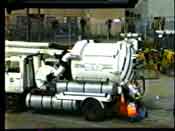
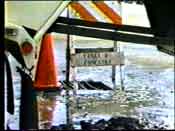
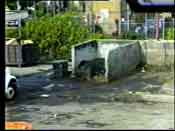
The Public Works' daily procedures involved spreading storm drain inlet debris collections up slope of the storm drain and allowing the leachate and some sediment to enter the storm system. Solids were then placed into a local landfill. The leachate and sediment traveled through the storm drain portal and found itself in the Bay. Our neighborhood first got a sense of the problem because of the noise associated with this process. Bright and early each morning a city tractor with a scoop would attempt to corral the hazardous waste debris.
The backup horn on the tractor and the scraping would cause anyone to look over the fence as indeed we did. What we didn't expect to find was that this entire process was unnecessary. You see, Public Works already had a facility to accommodate this hazardous waste. This environmental polluting, like so much of what occurs, was senseless. In this case, the choice to pollute or not to pollute was not a matter of cost. It was a matter of being conscious of the issues. The idea of a Toxic Management Department in City government is progressive, but Berkeley's Toxic Management regulatory impact on this particular pollution problem was not.Our West Berkeley group made a video to promote municipal awareness of the wastewater disposal and non point source pollution issues. Almost 100 copies of "Portal to the Bay" were directed at those responsible for developing water policy in the state. Included on this list were all nine regional water boards of California, all the counties of Region 2 which encircle the San Francisco Bay, and related environmental groups. Many dozens of municipal facilities have and will see "Portal to the Bay." The intent of our presentation was not to embarrass the City of Berkeley. We simply wanted to educate other municipalities, through Berkeley's mistakes, as to the seriousness of this environmental pollution. We also felt it important to point out some of the difficulties a regulatory agency encounters while attempting to regulate itself.
The problem of pollution cannot be blamed solely on the municipalities. Industrial, commercial and residential activities all contribute to polluting the eco-system of the Bay region. In Santa Clara County alone, an estimated 2.4 million quarts of crankcase oil are discharged into its storm system annually. Given that 1 gallon of oil can pollute 1 million gallons of water, it is no wonder that both experts and non experts are saying that the South Bay is dying.
The pollution begins in our neighborhoods and we all must become conscious of our part in harming the ecology of our region. As citizens we can no longer rely on government, its programs and their management to resolve all the problems with our environment. In our West Berkeley community it was necessary for residents to question and ultimately challenge the practices of our City's Public Works and Toxic Management Departments. Even the best of programs can be improved or better implemented. Our public concern does have an accumulative effect on the programs and practices that regulate our environment. Just ask Berkeley.
 |
 |
 |
 |
 |
 |
- Alameda County Urban Runoff Clean Water Program
Jack A. Lindley Water RESOURCES Manager, July 17, 1992 - California Region Water Board, Los Angeles,August 26, 1992
Winnie D, Jesena, P. E. Chief, Coastal Surface Waters Regulatory Unit
City of Milpitas, August 27, 1992
455 E. Calaveras Blvd. Milpitas, California 95035 - TOM BATES, MEMBER OF THE ASSEMBLY TWELFTH DISTRICT
California Legislature, October 14, 1992 - DEPARTMENT OF PUBLIC WORKS MARIN COUNTY, CALIFORNIA
Mehdi Madjd-Sadjadi, Director, August 18, 1992 - CITY OF PLEASANTON CALIFORNIA
June 24, 1992 - Santa Clara Valley Nonpoint Source Pollution Control Program
August 12, 1992 - Alameda County Urban Runoff Clean Water Program
Patty Spangler Public Information Coordinator, August 11, 1992
Written Responses from Those viewing the Video
Alameda County Urban Runoff Clean Water Program Public Participation ISSUES (below)
- Draft policy statement on public participation
To: Jack A. Lindley Water Resources Manager, ACURCWP
Eisenberg, Olivieri, & Associates, September 11, 1992- Summary of Results of September 16, 1992 Policy Level Subcommittee
Eisenberg, Olivieri, & Associates Environmental and Public health Engineering, September 18, 1992- Public Access to meetings of the Maintenance Subcommittee
Eisenberg, Olivieri, & Associates, October 20, 1992- Alameda County Urban Runoff Clean Water Program Management Committee Meeting
Draft Minutes, November 17, 1992
Alameda County Urban Runoff Clean Water Program
Jack A. Lindley Water RESOURCES Manager, July 17, 1992Dear Mr. Wood:
I am the program coordinator for the Alameda County Urban Runoff Clean Water Program (CWP). CWP is a consortium of Alameda County Agencies enumerated on our letter head.I am writing in response to the Berkeley videotape sent early last month. The coalition' s video has received wide circulation and has been effective in calling attention to Public Works practices that impact water quality. As as employee of the Alameda County Public Works Agency I can say that your reminder has solidified our agency's resolve to continue the cleanup practices in our corporation yard. I am sure your video has been a good reminder to the other agencies to "practice what YOU. preach'. Your video has been a good service in helping to clean up the stomwater discharges to the San Francisco Bay.
cc: Rick Ruiz, Deputy Director, M & 0
Patty Spangler, Public Information CoordinatorCalifornia Region Water Board, Los Angeles
August 26, 1992
VIDEO TITLED, "PORTAL TO THE BAY"
Thank you for sharing the video, "Portal to the Bay", with us which we received on August 24, 1992. The video offers a rather distinct perspective into non-point source pollution. We intend to share this video with the cities in the Los Angeles Region and other interested parties to increase, awareness of proper waste disposal practices.
Thank you for taking an active role in water quality issues.
Winnie D, Jesena, P. E. Chief, Coastal Surface Waters Regulatory UnitCity of Milpitas, August 27, 1992
455 E. Calaveras Blvd. Milpitas, California 95035
Dear Mr. Wood:
I am very pleased to send you this letter regarding the conversation we had on August 27, 1992. As you know, storm water discharge has become one of the main issues of the Environmental Protection Agency. The City of Milpitas along with surrounding communities has developed a storm water management plan to control pollutants from entering our creeks, rivers and eventually San Francisco Bay. A key element in this plan is the education of ourselves and the community about our roles in preventing pollutants from entering our storm drain. Materials like your video is going to play an important role in achieving this task.We respectfully request your written approval for the right to copy and show your video on local cable television. For any further information or question please contact me at (408) 942-2374.
Thank you in advance.
Babak Kaderi Engineering Aide, Land Development
cc: Land Development EngineerTOM BATES, MEMBER OF THE ASSEMBLY TWELFTH DISTRICT
California Legislature, October 14, 1992
Dear L A Wood:Thank you for your letter and the information on the Bancroft Guardian Coalition and the Alameda County Urban Runoff Clean Water Program (CWP).
As you know, I am very interested in everything that affects the quality of the San Francisco Bay ecosystem and would be very interested in seeing your video, "Portal to the Bay". Unfortunately, I misplaced the film. If you do have an extra copy, I would greatly appreciate if you would send it.
Again, thank you for your letter and for your work in this important area.
Sincerely,
Tom Bates, Member of the AssemblyDEPARTMENT OF PUBLIC WORKS MARIN COUNTY, CALIFORNIA
Mehdi Madjd-Sadjadi, Director, August 18, 1992
Attention L A Wood
RE: Surface Runoff Pollution Plans
Dear Mr. Wood:Thank you for the copy of your video "Portal to the Bay". Although some of the audio was hard to understand I think this is a good step in enhancing public awareness of the problem of pollution from surface runoff. I will be showing it to some of our Foremen who, I am sure, would not particularly relish being the "star" of a similar film here in Marin.
As I explained in our telcon, the County of Marin has a long history of attention to this issue although the various elements have never been pulled together into a Program with a capital P. I am sure, however, that there are areas where such a "pulling together" will result in both better efficiency and effectiveness including the "disposal issue" you have so effectively raised.
Thank you again for the video and the opportunity to comment. If you have any questions or wish to discuss this matter further, please feel free to call me at 499-6528 any time during regular business hours.
John M. Wooley Assistant Civil Engineer Marin County Flood Control and Water Conservation DistrictCITY OF PLEASANTON CALIFORNIA
June 24, 1992
Dear Mr. Wood:I am returning to you the enclosed video tape you brought by earlier this month. I am pleased to inform you that the City of Pleasanton is in conformance with requirements established by the Alameda County Urban Runoff Clean Water Program in regards to disposal of street sweeping and storm drain inlet debris.
Current procedures include disposal of street sweeping debris at the local landfill. Storm drain inlet debris is spread out for drying purposes with the leachate draining into a sediment basin where the solids settle and the liquid either evaporates or percolates into the ground. The solids are then placed into the local landfill.
Possible modifications to disposing of storm drain inlet debris may occur pending establishment of best management practices by the Program. I thank you for the use of the information provided on the video tape and encourage your coalition to remain active in increasing awareness of runoff pollution and its effects on San Francisco Bay.
Very truly yours,
Joseph Elliott
Director of Public Works and Utilities
Santa Clara Valley Nonpoint Source Pollution Control Program
August 12, 1992Dear Mr. Wood:
Thank you for the video "Portal to the Bay" which will be presented to the 13 cities, County of Santa Clam and Santa Clara Valley Water District personnel that are responsible for implementation of the Nonpoint Source Control Program in the Santa Clam Valley.
I learned of "Portal to the Bay" from the Alameda County Public Works staff. I found the video to be an excellent example of the importance for municipalities to address their nonpomt sources of pollution as we move ahead with implementation of nonpoint source programs.
I am enclosing some of the materials we have developed as part of the Santa Clara Valley program and are sharing these with Alameda and other storm water programs being developed throughout the State.
Again, thank you for sharing the video that you have prepared.
Roger B. James ,Chairman management Committee
Alameda County Urban Runoff Clean Water Program
Patty Spangler Public Information Coordinator, August 11, 1992Dear Mr. Wood:
I received my carbon copy of your August 3 letter to Mr. Roger James. As you are aware, the video "Portal to the Bay" was not developed for the Alameda County Urban Runoff Clean Water Program, although your letter implies that it was.In interest of accuracy, I will clarify this point with Roger James and would ask that, in the future, you rightfully credit the Bancroft Guardian Coalition with the production of the video “Portal to the Bay”.
Eisenberg, Olivieri, & Associates
Environmental and Public health Engineering, September 18, 1992
Mr. Jack Lindley Water Resources Manager Alameda County Public Works Agency
399 Elmhurst St. Hayward, CA 94544Subject: Summary of Results of September 16, 1992 Policy Level Subcommittee
Dear Jack:
This provides a summary of this recent Policy Level Subcommittee meeting which was held to discuss three main issues. The first issue discussed was the proposed Public Participation Policy. The second issue discussed was the process for evaluating proposals submitted to implement pilot storm water management projects. Lastly, the third issue involved the review of a draft letter from the Program requesting that the draft Comprehensive Conservation and Management Plan be changed.The following people attended this meeting: Richard Wetzig Alameda County Robert Hale Alameda County Dick Asimus City of Fremont Michael Neary City of Oakland Robert Marek City of Berkeley Scott Wiley Alameda County Shelly Sack WCC Ken Susilo WCC Lee Thompson City of Dublin Jack Lindley Alameda County Joe Lucia City of Hayward Diane Heinze EOA. Inc. Fred Jarvis EOA, Inc.
Proposed Public Participation Policy
Changes to the bylaws to incorporate a public participation policy were discussed at the August Policy Level Subcommittee meeting and copies of the draft policy were distributed at the August Management Committee meeting for comment by September 11. The only comment received was from a citizen named L A Wood. Mr. Wood believes the proposed policy is too restrictive. The Policy Level Subcommittee chose to postpone making any recommendation on the public participation policy until they have had an opportunity to review Mr. Wood's letter. A copy of his letter will be distributed at the September Management Committee meeting.
Draft policy statement on public participation
To: Jack A. Lindley Water Resources Manager, ACURCWP
L A Wood, September 11, 1992The Alameda County CWP Management Committee is reviewing a draft policy statement on public participation. (Please refer to Agenda Item No. 6 from the August 25,1992 Management Committee Meeting.) The Bancroft Guardian Coalition would like to contribute a PUBLIC perspective to this discussion on citizen participation in the Urban Runoff Clean Water Program.
As you will recall, in early June of 1992 the Bancroft Guardian Coalition released a video concerned with municipal government activities. "Portal to the Bay" was our group's attempt to highlight several of the problems found in our Public Work's Corporation Yard in Berkeley and that we suspected exists within the other municipal maintenance yards of Alameda County's CWP.
The CWP Maintenance Subcommittee scheduled a showing of "Portal to the Bay" for August 5,1992. Our Coalition responded to this notice by suggesting to this subcommittee that we would like to contribute to the discussion by attending the August meeting. We were not invited. The fact is, a majority of the members of the Maintenance Subcommittee specifically voted to not invite the Bancroft Guardian Coalition. (Please refer to the minutes of the Maintenance Subcommittee August 5.)
The Maintenance Subcommittee's intent has been to silence the debate concerning disposal priority by excluding those who raise the question. At present, both the public and the Bancroft Guardian Coalition are the target of this exclusionary maneuvering. By mid June our Coalition had approached all the program's municipalities. We offered each a video and simply asked what their particular practices were with regard to disposal. Here again a majority of the participating cities chose not to respond.
Our first encounter with the administrative tactic of non response was from Public Works in Berkeley. It was no surprise to the coalition that twelve of the thirteen other municipalities were not open to our public survey or ideas. At this point, our group began written correspondence with the Maintenance Subcommittee through E.O.A. Our group expressed concern over the integrity of a environmental cleanup program that fails to include a conscientious disposal policy with adequate implementation.
The Maintenance Subcommittee released its Best Management Practices on June 23,1992. This document contained no Tier I for municipal disposal. This was in contrast to our group's call for a minimum standard to reflect the seriousness of the disposal problem. It was our coalition's efforts that caused the Maintenance Subcommittee to update its BMP's on July 28,1992 for disposal. Unfortunately, this change has only resulted in a brief discussion on proper disposal and has left implementation only as a matter of discretion.Alameda's CWP followed our public lead by also surveying its municipal membership. Over half of this survey was directed at the issue of priority assessment for disposal. Our group had hoped that the survey could look beyond this point and recognize the need for immediate operational changes in some of its participants' municipal activities. Instead, the survey was calculated to divert the discussion away from the issue of disposal. This is also the intent of the program's draft statement on public participation.
In regard to public participation, a major shortcoming has been the failure of both Alameda County and Berkeley's Public Works Department to respond to our written correspondences in a substantive or timely manner. This idea is central to the public's ability to participate. Written exchanges form the basis of constructive discourse. Handshaking and accommodation do little more than obfuscate public participation. Citizen access to agency information and, most importantly, to critical policy meetings represents a considerable part of public participation. When an institution fails to respond to public inquiry and interest, it fails the public trust.
Our coalition recognizes the need for outside scrutiny of Alameda's CWP. Regulators generally have problems regulating themselves. This can easily be seen in both the policy development of the program and in our presentation, "Portal to the Bay." I think this need is made even more apparent by the Alameda program's attempts to restrict our group from subcommittee participation. The program has failed to acknowledge the public contributions that can and have been made to the CWP at this subcommittee level. If a subcommittee chooses not to consider an issue (such as has been done with disposal), then the public is excluded from any review of the issue. In this context, the Management Committee represents an obstacle to what we have demonstrated to be constructive public input.
Our group recognizes that we have interfered with the apparent objectives of the Maintenance Subcommittee. Their recent actions reflect an avoidance of policy development that would cause its membership to change their disposal practices. It should be noted that in a program whose central focus is cleanup, it would appear to be fraudulent for a given municipality or county to levy funds from the public and then fail to embrace an adequate policy development and implementation to secure that same cleanup.
In the name of the public, we ask that the Management Committee reconsider the restrictive measures it is proposing with regard to public participation and access to policy development. We would like the current Maintenance Subcommittee to be eliminated and/or a new Maintenance Subcommittee created to readdress the priority for implementation of municipal disposal activities, Tier I.
To the program's municipalities, cost is the major consideration in the implementation of Tier I for disposal. We see this as the sole rationale for the Maintenance Subcommittee's adopted disposal policies. Our public group senses the shortsightedness of this policy position. The associated costs of proper disposal are little compared to the escalating costs of future environmental cleanup if our current actions are not sound. The changes that we have suggested are beneficial to both the public interest and that of the ecology of the region.
Being a regulator, you are afforded the opportunity to set many of the rules and standards that govern your relationship to the public. The regulatory role is an important one. Those in private industry look to you for guidance. The success of the runoff program will be measured by Alameda's ability to establish meaningful standards and to draw consensus from all those concerned, including the public.
Respectfully, L A Wood
cc: Tom Bates, Assemblyman, District 12 Nancy Nadel, EBMUD Board President Mayor Hancock, City of Berkeley Robert Marek, Engineer, City of Berkeley
Public Access to meetings of the Maintenance Subcommittee
Eisenberg, Olivieri, & Associates, October 20, 1992 October 20, 1992
Re: Reference is made to your letter of September 11, 1992 to Mr. Jack Lindley concerning access to meetings of the Maintenance Subcommittee.Dear Mr. Wood:
I have read your letter which discusses the decision of the Maintenance Subcommittee to restrict attendance at regular meetings of the subcommittee to persons who have direct technical influence on the methods and equipment being used by Alameda County, and the other public agencies in the County, to clean streets and storm drains. I am sorry you chose to disagree with the decision, but we feel there is ample basis for the decision. It certainly was not made to attempt to insulate or isolate the subcommittee from the scope of the problem we are attempting to solve. I am certain that not one member of any public agency participating in the Clean Water Act process wants to contribute in any way to continuing any level of pollution of San Francisco Bay, or your neighborhood for that matter.None of the participants in the Clean Water Act program would prefer to continue outmoded, crude and ineffective methods of collecting and disposing of waste materials. Until the Clean Water Act there was little or no political (read "economic") support to help the people in the field find solutions to some really hard problems. It is my hope that what the activities of the Clean Water Act participants produce is exactly what you want in your community, and on a County wide scale.
The Subcommittee has carefully viewed the video tape you produced, based on your experience with the City of Berkeley, and can fully appreciate your concern with what you documented. Your tape did not elicit any questions from any member of the subcommittee which the members felt could have been better answered by your appearance in person. I don't think that any of the Subcommittee members felt a need to further identify the problems to be addressed - we all have first hand knowledge of the situation. Frankly, none of the members of the subcommittee were greatly surprised by what they saw, and most were more than a little bit embarrassed. Historically the problems you identified have not been given the priority they perhaps should have had, for a variety of reasons - none of them very good.
Alameda County Urban Runoff Clean Water Program Management Committee Meeting
Draft Minutes, November 17, 1992
Jack Lindley called roll and determined that all municipalities were present except the following: Albany, Emeryville, Livermore, Piedmont, and San Leandro.2. Introduction of Public Present and Public Comments
The following people introduced themselves: L A Wood from the Bancroft Guardian Coalition; Carolyn Erbele from the Bancroft Guardian Coalition; Kathy Kramer from the Aquatic Habitat Institute; Deborah Rex and Hank Ackerman from Alameda County; and Annie Fong from the City of Oakland.
Mr L A Wood thanked the Management Committee for reorganizing the meeting format so that he does not have to wait until the end of the meeting to speak. He also thanked Bill Copeland for his extensive letter which, while it was too late in coming, was appreciated. These developments are encouraging according to Wood. He also thanked the Maintenance Subcommittee, and he appreciates their using the "Portal to the Bay" video, which Carolyn Erbele and he produced, at the upcoming maintenance workshop.
Wood stated that he is concerned about the implementation of the Program as regards the municipal maintenance activities. In particular he would like to see a policy determination by the Management Committee and the Maintenance Subcommittee on the opt out program being implemented in Berkeley. The City of Berkeley views street cleaning as a litter control activity; street cleaning is done for more than litter control. In Berkeley many people can opt out of having street sweeping and thus there is no assurance that BMPs are being conducted. Wood stated that he will provide copies of Berkeley's street sweeping program and a copy of Berkeley's opt out program. He would like to see the opt out program discontinued in Berkeley.
Carolyn Erbele elaborated further on the opt out program. According to Erbele, 60 percent of the residents on a block can opt out of street sweeping if they agree that they will take care of removing leaves and trash. This does not replace street sweeping which does pick up metals, oils, and asbestos according to Erbele.
All Rights Reserved